On this page
How should a buyer verify accepted output from a complete injection molding cell before handover?
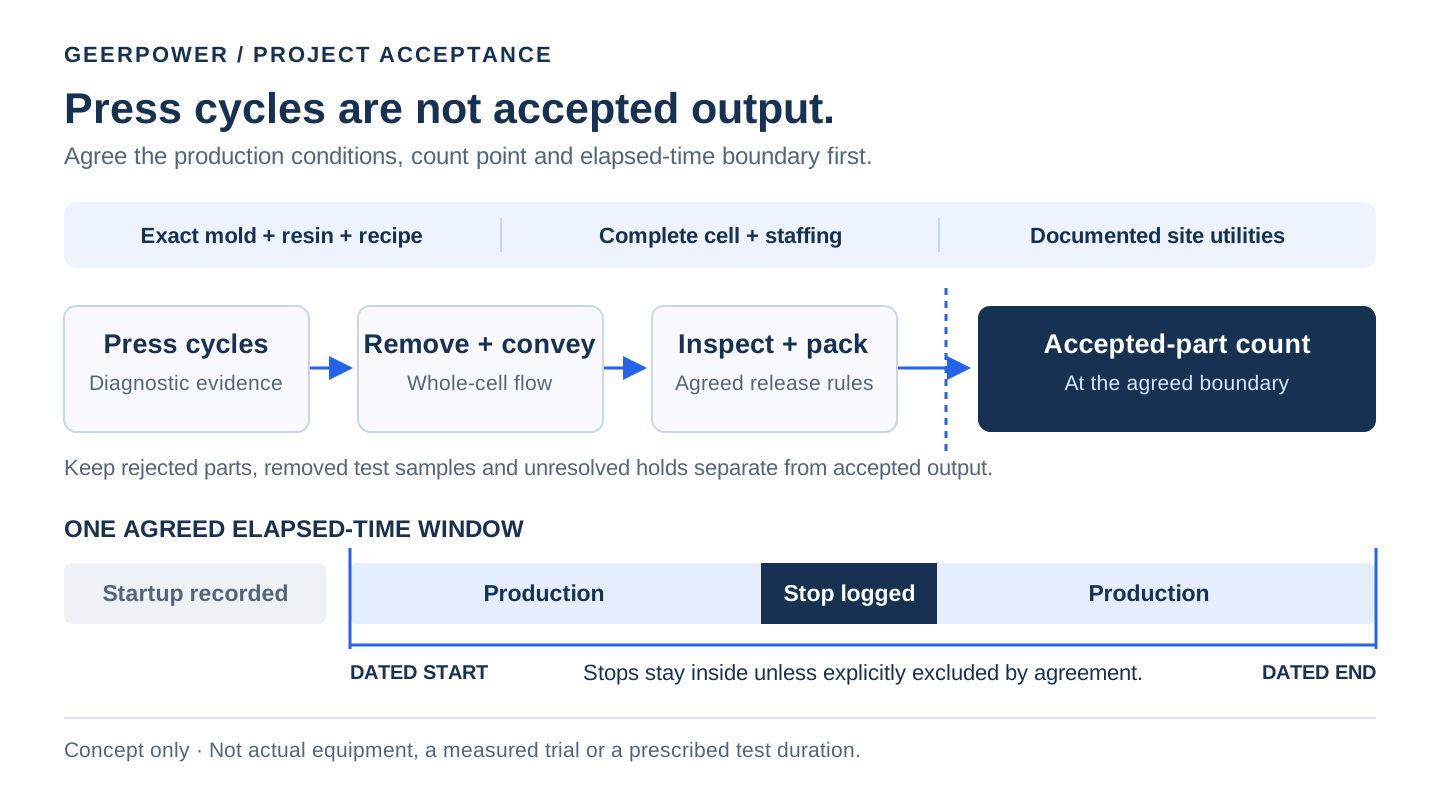
Agree the exact production configuration, quality requirements, downstream count point and elapsed-time window before the trial. Count only parts attributable to that window that meet the agreed release rules; identify scrap, test samples and inspection holds separately. Record every stop and any approved time exclusions. Compare accepted parts per elapsed hour with the written target, then sign a pass, an open-item record or a retest plan. Press cycles alone cannot establish whole-cell accepted output.
Decision checklist
- Freeze the part, mold, resin, recipe, equipment, labor and site-utility conditions.
- Write one count point, one test window and explicit rules for stops and work in progress.
- Separate produced, rejected, sampled, held and finally accepted quantities without double counting.
- Agree the output target, quality release evidence, signatories and retest triggers before starting.
Define the result the cell must deliver
Start with the deliverable: accepted individual parts, complete sets or packed units. A four-cavity mold does not necessarily make four saleable units each cycle. A disabled cavity, damaged take-out, downstream reject or incomplete set changes the result. State the unit and quality criteria alongside the output target; do not leave either for interpretation after the run.
HUARONG distinguishes the factory acceptance baseline from site verification with connected utilities and peripherals, and describes signed acceptance records. Use that distinction to identify what a factory trial covers and what must be repeated at the installed site. A dry run can demonstrate motion, but without the agreed material and product it cannot prove accepted production output.
The following is a recommended buyer test plan, not a universal acceptance standard. Duration, thresholds, sampling and contractual consequences must be agreed for the project. This is a bounded handover test, not an OEE calculation or a claim about long-term capacity.
Freeze the production conditions before the clock starts
Identify the part drawing revision, mold ID, active cavities, resin grade and lot, colorant or regrind allowance, drying condition and approved process recipe. Record the press configuration, robot and gripper, conveyor, inspection station, reject route and packing method. A run using a substitute resin or temporary hand removal is not automatically representative of the purchased cell.
Include operators and their tasks, packaging consumables, available buffer space and any planned replenishment. Record electrical supply, cooling-water and compressed-air conditions at the relevant connection points under load. State which other factory loads should operate during a site trial. The agreed operating envelope needs project-specific values, not generic limits borrowed from another installation.
Confirm safe readiness and stabilization criteria separately from the timed trial. Record startup waste and the stabilization evidence, even when startup is outside the output window. If equipment, recipe or staffing changes during the trial, log the change and apply the pre-agreed continuation or restart rule; do not silently combine unlike conditions.
Make elapsed time and stop rules unambiguous
Write the start and end event, full date, time zone and clock source. A run crossing midnight still needs one continuous elapsed interval; a calendar-day production total is not a substitute. Align controller, inspection and manual event timestamps, or document their offsets, so a stop or reject can be placed inside the correct window.
For a whole-cell output commitment, a useful default is to retain all stops inside the agreed window: robot recovery, conveyor blockage, inspection pauses, packing replenishment and material interruptions. The contract may allocate exclusions differently. Define those exceptions beforehand, record their start, end and reason, and show gross elapsed time and any adjusted time separately. Never present a running-time rate as an elapsed-time result.
Choose a duration that exposes the agreed production and replenishment events. There is no single duration established by this guide. Do not shorten the window after a favorable stretch or remove an inconvenient stop retrospectively. Preserve the original record even when an authorized retest is needed.
Count accepted parts at one agreed boundary
Mark the count point on the cell layout: for example, released parts entering a labeled carton after the agreed inspection. Clear or identify pre-trial work in progress and record opening counts. Agree whether eligibility follows passage through that point during the window or a traceable production cohort. Define how parts still on the conveyor at the end are treated; do not mix the two counting bases.
Use mutually exclusive dispositions for the trial quantity: accepted, rejected, removed test samples and unresolved holds. Keep startup parts outside the trial separate. If sampled pieces can later be returned, specify the release and reconciliation rule; destructive samples cannot also count as delivered parts. Record held lots and update their disposition without changing the original time boundary.
OPC 40083 distinguishes total, good, bad and test-sample part counters. Its cycle-quality definition treats a good cycle as an assumed quality classification based on machine detection. These terms help label a record; they do not establish independent downstream acceptance or prove GEERPOWER supports an OPC interface. Verify actual counter behavior and reconcile it with the physical count.
Keep theoretical rate separate from measured output
Hypothetical example only: a 20-second cycle and four active cavities give a theoretical rate of 3,600 ÷ 20 × 4 = 720 parts per hour. That assumes uninterrupted cycles with every cavity producing a part. It does not deduct stops, rejects, test samples or downstream losses, and is not a guaranteed cell output.
Suppose an illustrative two-hour elapsed window records 335 completed cycles and 1,340 produced parts. After reconciliation, 60 are rejected, 20 are removed test samples and 40 remain on inspection hold. The released quantity is 1,340 − 60 − 20 − 40 = 1,220 accepted parts. Measured accepted output is therefore 1,220 ÷ 2 = 610 parts per elapsed hour, not 720.
All figures and the two-hour duration are invented to explain the arithmetic. In a real record, reconcile the 1,340 parts with the chosen boundary and work-in-progress rule rather than assuming cycle multiplication proves it. The 40 held parts remain excluded until disposition. Passing still depends on the agreed target, quality evidence and other acceptance conditions, not this example.
Put the test agreement on one worksheet
Attach a revision-controlled worksheet to the acceptance plan before the trial. Name the witness and evidence owner for each row. A video can support the timeline, but it cannot replace the count reconciliation, inspection release or signed result.
| Agreement item | Record before or during the trial | Close-out evidence |
|---|---|---|
| Output and quality | Unit, target, drawing revision, inspection and sampling rules | Accepted quantity and quality release |
| Configuration | Mold, cavities, resin lot, recipe and equipment revisions | Witnessed configuration and change log |
| Site and labor | Utilities under load, operators, packing and replenishment | Readings and actual operating conditions |
| Time boundary | Dated start/end, time zone, clock and stop/exclusion rules | Gross elapsed time and any separate adjusted basis |
| Count boundary | Count point, opening balance and work-in-progress rule | Closing balance and physical-count reconciliation |
| Dispositions | Reject, sample, hold and release categories | Non-overlapping totals and traceable held lots |
| Decision | Pass criteria, authorized signatories and retest triggers | Signed outcome, open items, owners and deadlines |
Sign a result, not an impression
Issue a record identifying the worksheet revision, configuration, time window, actual conditions, output calculation, inspection evidence and deviations. Mark the outcome explicitly: pass against the agreed criteria; open items with a defined acceptance restriction; or retest required. Do not treat a pending inspection hold as an unconditional pass.
For each open item, name the responsible party, corrective action, due date and evidence needed for closure. Specify whether a change requires the whole run or only a defined check to be repeated, and who may approve that decision. Preserve both runs and explain why the new result is comparable. Payment, warranty or handover consequences belong to the agreed contract, not a generic checklist.
For a GEERPOWER turnkey project review, send the part and mold data, target accepted output, site conditions, downstream layout and draft worksheet. Ask for confirmed scope to be separated from unresolved evidence. Final configuration, throughput, interface support and acceptance results must be confirmed against the agreed scope and exact project records.
Common buyer questions
Does a 20-second machine cycle prove finished-part output?
No. Cycle time and active cavities give a theoretical rate. Accepted output also depends on stops, part handling, inspection, rejects and the agreed count boundary.
How long should a run-at-rate acceptance test last?
Agree a project-specific window that covers the production conditions and events being evaluated. This guide prescribes no universal duration; the two-hour example is hypothetical.
Should the clock stop when the conveyor or packing station stops?
For elapsed whole-cell output, retain the interruption unless the written plan explicitly allows an exclusion. Disclose gross time and any adjusted time separately.
Can a machine good-part counter be the final acceptance count?
Only if its meaning, behavior and boundary meet the agreed release rules and are verified. A machine classification alone does not prove downstream quality or packing acceptance.
What happens to parts awaiting laboratory or dimensional inspection?
Identify them as held, not accepted. Keep the result provisional where necessary, then reconcile the disposition against the original trial lot and time window.
Can factory acceptance replace the site run?
Only within the scope explicitly agreed by the parties. Differences in installed utilities, peripherals, staffing or packing can leave site output unverified.
Does a successful dry run establish production capacity?
No. A dry run without the agreed mold, material and production flow cannot establish accepted-part throughput. Keep functional checks and production evidence distinct.
What should trigger a retest?
Use the triggers agreed before testing, such as an unmet output criterion, invalid count reconciliation or a material configuration change. Name the approving party and preserve the original result.
Sources and references used for this guide
This guide supports early project planning. Final machine selection and commercial configuration must be confirmed from the actual part, mold, material, factory utilities and production target.