On this page
How do you verify that a new injection molding cell has enough compressed air at production load?
Ask the equipment supplier to specify minimum inlet pressure, air quality and demand for the configured consumers. Agree where and how to log pressure, then measure at the equipment inlet during a representative production sequence, including overlapping demand. Compare the recorded minimum and the equipment response with the agreed acceptance conditions. A compressor rating, an idle gauge reading or a supplier trial on a different air supply is not evidence that the installed cell passes.
Decision checklist
- Mark the plant handoff and the equipment test points on the utility drawing.
- List simultaneous consumers and record the reference conditions behind each flow value.
- Agree the inlet limits, sampling method, production sequence and sign-off owner before the trial.
- Record minimum pressure and time-aligned events, not just the average or idle reading.
- Keep temporary factory-test air conditions separate from site acceptance evidence.
Find the air consumers that overlap
Start with the planned operating sequence. Depending on the configuration, pneumatic tooling, a vacuum ejector, an air blow-off, a valve gate or a downstream fixture may draw from the same branch. Check what is actually included. An all-electric press can still be part of a cell with pneumatic auxiliaries; the machine drive label does not settle the utility requirement.
Separate steady demand from short events. A supplier may give a per-cycle consumption figure and another may give a flow rate under stated conditions. Record the unit, the reference conditions and the cycle basis before comparing them. Do not treat an average converted from one cycle as the instantaneous demand for coincident events.
Kaeser distinguishes capacity, air quality and pressure at the point of use. Atlas Copco explains how restrictions and temporary demand peaks affect pressure delivered to a consumer. Use those concepts to structure the RFQ, then request values for the selected equipment.
Put the measurement boundary in the quotation
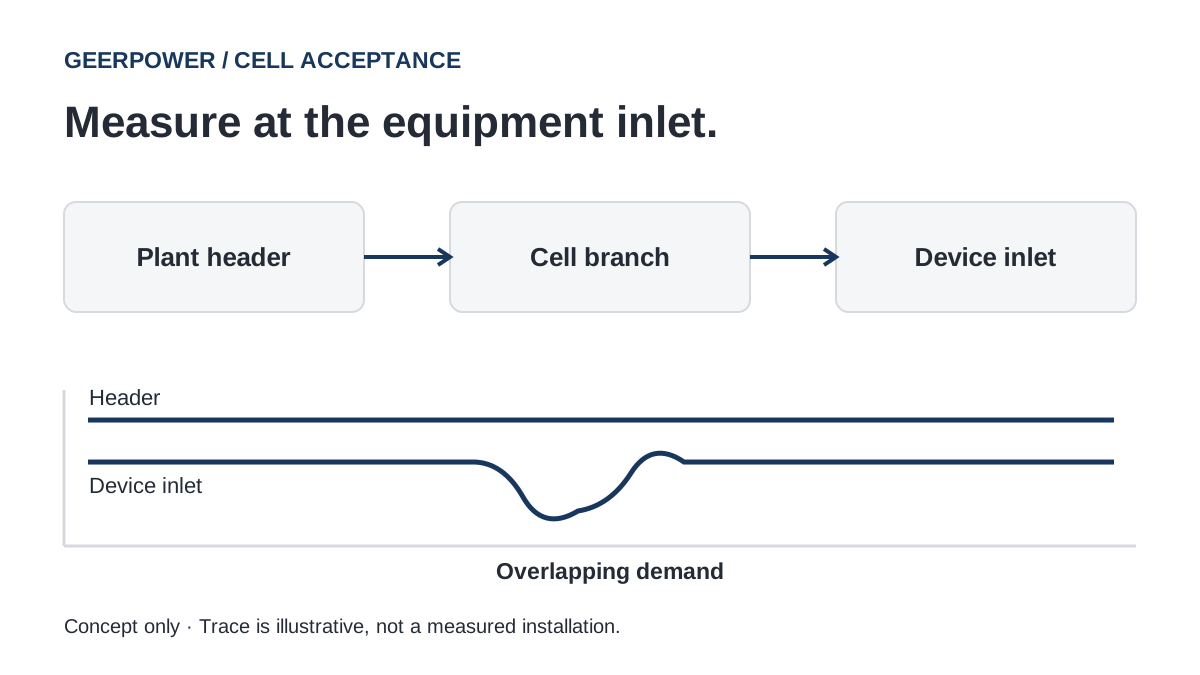
The plant header and the device inlet are different measurement points. Pipework, treatment equipment, couplings and the local regulator can introduce losses between them. Mark the supplier's specified point on the drawing and name who is responsible for the branch, local preparation and last connection. This prevents an argument about what the gauge reading represents after installation.
Agree the air quality requirement where the device receives air. Filtration and drying are separate from pressure, and the selected treatment equipment must be evaluated at the expected flow. Do not assume a site-wide air description or a generic quality class is adequate for every device.
| RFQ item | What to record | Acceptance question |
|---|---|---|
| Equipment inlet | Exact test point, required pressure range and permitted measurement method | Was pressure measured where the limit applies? |
| Peak demand | Consumer list, flow units and reference conditions, time overlap and other plant loads | Did the trial reproduce the agreed simultaneous demand? |
| Air quality | Equipment requirements and assigned filtration, drying and condensate handling scope | Does the evidence cover the required point of use? |
| Test record | Cycle sequence, measurement interval, minimum pressure, alarms and relevant device behavior | Can the buyer trace a drop to the corresponding event? |
| Responsibility | Plant connection, cell-side supply, instrument and corrective-action owners | Who closes an issue and repeats the test? |
Use the pressure trace to decide what still needs evidence
Illustrative example: assume a device supplier specifies 5.5 bar gauge as the minimum at its inlet under the agreed operating condition. If the header stays at 6.2 bar while the device inlet reaches 5.1 bar during an overlapping take-out and blow-off event, the recorded inlet minimum is 0.4 bar below the criterion. Those figures are made up to show how to interpret a trace; they are not equipment settings or site requirements.
A healthy header reading does not identify the cause of that dip. Ask the responsible engineer to compare measurement points and verify the demand sequence and local components. A slow gauge may miss a transient; agree an instrument and sampling method suited to the events being evaluated. Do not raise pressure, alter protection or bypass interlocks to make a trial pass.
Factory acceptance testing can verify behavior on the supplier's documented air supply. Site acceptance must close the differences that affect the installed cell: the actual branch, shared loads, configuration and production sequence. If those conditions are absent, record a provisional result with an owner and a retest condition rather than closing the item.
Send the utility drawing and the planned operating sequence
For a project review, share the cell layout, available plant supply data, device list and intended cycle or throughput. Identify which equipment can operate together and any existing air-quality or pressure records. Ask the quotation to separate the plant connection, supplied cell components and loaded test scope. Actual flow, pressure limits, equipment selection and acceptance criteria depend on the final configuration and must be confirmed in writing.
Common buyer questions
Is the compressor nameplate enough to accept the cell?
No. Confirm what pressure and flow reach the equipment during the agreed demand sequence, along with the required air quality.
Can the supplier's factory trial replace the site air check?
Only the checks that the parties explicitly agree are representative can be carried forward. Site branch losses and simultaneous plant demand still need to be addressed.
Where should the pressure be logged?
At the test point specified for the equipment's inlet limit. Record the header as a comparison point when it helps distinguish upstream supply from branch loss.
Sources and references used for this guide
This guide supports early project planning. Final machine selection and commercial configuration must be confirmed from the actual part, mold, material, factory utilities and production target.