What should an RFQ include for injection molding a plastic part around metal inserts?
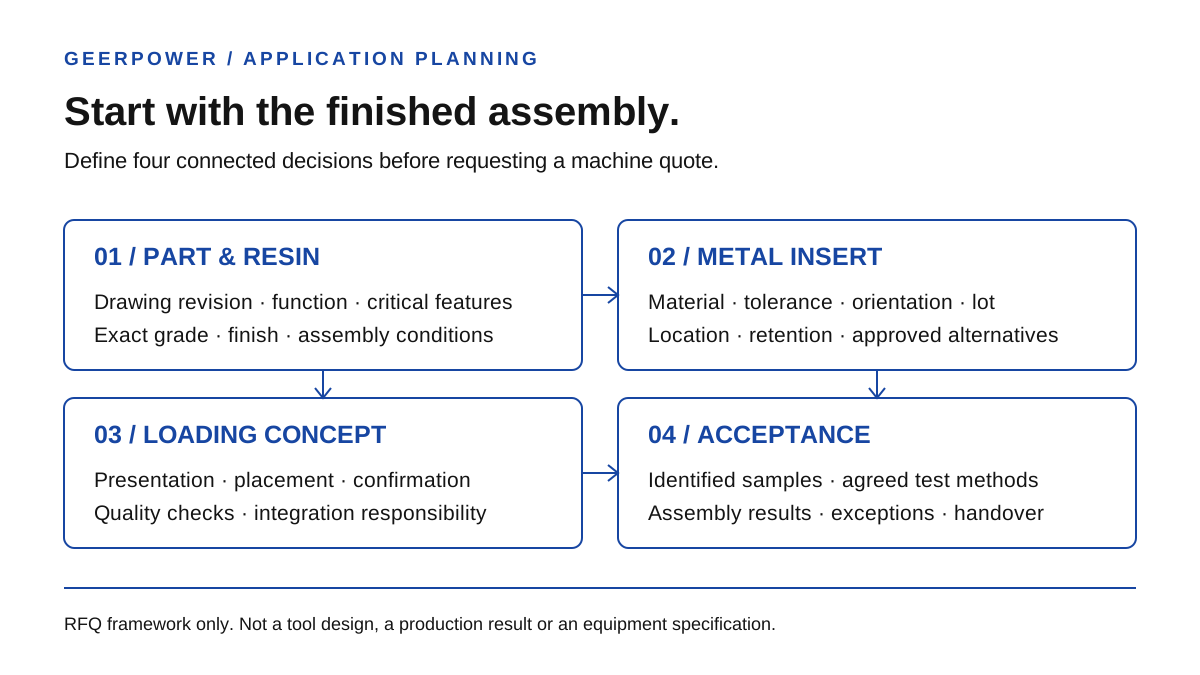
Supply the finished-part and insert drawings, exact resin grade, insert material and finish, required assembly performance, production demand and loading concept. Ask the supplier to define insert location, retention, inspection and exception handling alongside the mold and machine. Agree how the finished assembly will be tested before comparing prices or accepting a cycle-time claim.
Decision checklist
- Confirm whether the insert must be molded in or can be installed after molding.
- Control both the plastic-part revision and the purchased insert specification.
- Include insert feeding, loading, detection and rejected-part handling in the project boundary.
- Use the real assembly requirements to agree trial evidence and acceptance criteria.
- Separate tooling, automation, trial materials and receiving-site work in the quotation.
Start with the assembly problem, not a machine tonnage
An electrical enclosure may need repeated screw assembly; an industrial housing may need a metal sleeve at a loaded interface. These are useful insert-molding discussion scenarios, not reported GEERPOWER customer cases. The buyer's first question is what the metal feature must do in service. A threaded fastening point, a bearing interface and an electrical terminal require different drawings and different evidence.
Protolabs describes insert molding as placing a preformed component, often metal, in the mold before molding plastic around it. Its examples include threaded inserts, bushings and sleeves. That explains the process family; its published size limits, materials and turnaround times are supplier-specific and should not be treated as GEERPOWER specifications.
Write the intended function into the RFQ: assembly frequency, loading direction, mating component and any required environmental exposure. Where electrical insulation, sealing or regulated performance is involved, identify the responsible design authority and the applicable product requirements. Do not assume a successful molding trial establishes those properties.
Compare molded-in inserts with post-molding installation
For a threaded fastening feature, ask the design team whether molding around the insert is required or whether a separately validated post-molding installation could satisfy the assembly specification. This is a route-selection question, not permission to substitute insert types. Each route needs its own compatible insert, plastic geometry and production method.
An embedded terminal or a component that must be encapsulated may not have the same alternatives as a threaded boss. Request a design review when the drawing and proposed manufacturing route disagree. The following comparison is a buyer-side scope framework, not a claim that one process is always stronger, faster or cheaper.
| Route | What enters the quotation | Decision evidence |
|---|---|---|
| Molded-in insert | Insert location in the tool, loading method, detection and mold-trial scope | Approved assembly results using production-intent inserts and resin |
| Post-molding installation | Compatible boss and insert design, installation equipment, fixtures and separate inspection | An approved installation process and assembly performance results |
| Design change or alternative fastening | Drawing approval, mating-part impact and any new tooling | Written design-owner acceptance before suppliers quote a substitute |
Build one controlled input pack for every supplier
Quotations become difficult to compare when one supplier sees only a plastic CAD file while another receives the insert drawing and a sample assembly. Send the same revision-controlled package to each bidder. Mark what is released, what is provisional and who can approve changes. Photographs are useful context, but they do not replace dimensions or acceptance requirements.
Include the exact resin grade and reinforcement specification rather than only a family name such as nylon. For purchased inserts, record the manufacturer and part number or the controlled manufacturing drawing, material, finish and permitted alternatives. Require written approval before changing an insert source or finish during trials.
| Input | Detail to provide | Question to resolve |
|---|---|---|
| Finished part | 2D drawing, CAD, critical features, appearance zones and mating parts | Which dimensions and surfaces control assembly acceptance? |
| Metal insert | Drawing or part number, material, finish, tolerance and packaging | Who supplies production-intent samples and approves substitutions? |
| Resin | Grade, reinforcement, color and supplier processing information | Which material changes require a renewed trial? |
| Production demand | Required good parts, shifts, cavity proposal and product mix | Does the output estimate include loading and inspection? |
| Loading | Manual or automated concept, insert presentation and orientation | Who defines the safe loading concept and error detection? |
| Inspection | Assembly tests, critical dimensions, sampling and traceability | Who approves methods, limits and exceptions? |
| Factory fit | Existing press details, utilities, layout and destination | What is supplied, reused or installed by the receiving site? |
Review insert location and loading as part of the mold project
Ask the mold supplier how the insert is located, which features establish its position and what prevents an unsuitable or incorrectly presented insert from reaching the next production step. Have the supplier identify areas where plastic must be excluded, such as a functional thread or a specified contact surface. Request a drawing-based review instead of accepting a generic statement that the insert will be held securely.
SPIROL's molded-in insert information describes placement on core pins and explains that insert geometry can affect orientation requirements. Its application guidance also stresses that performance must be assessed in the actual assembly. These are reasons to control the insert and validate the proposed process, not evidence that a particular insert will meet an unstated torque or pull-out requirement.
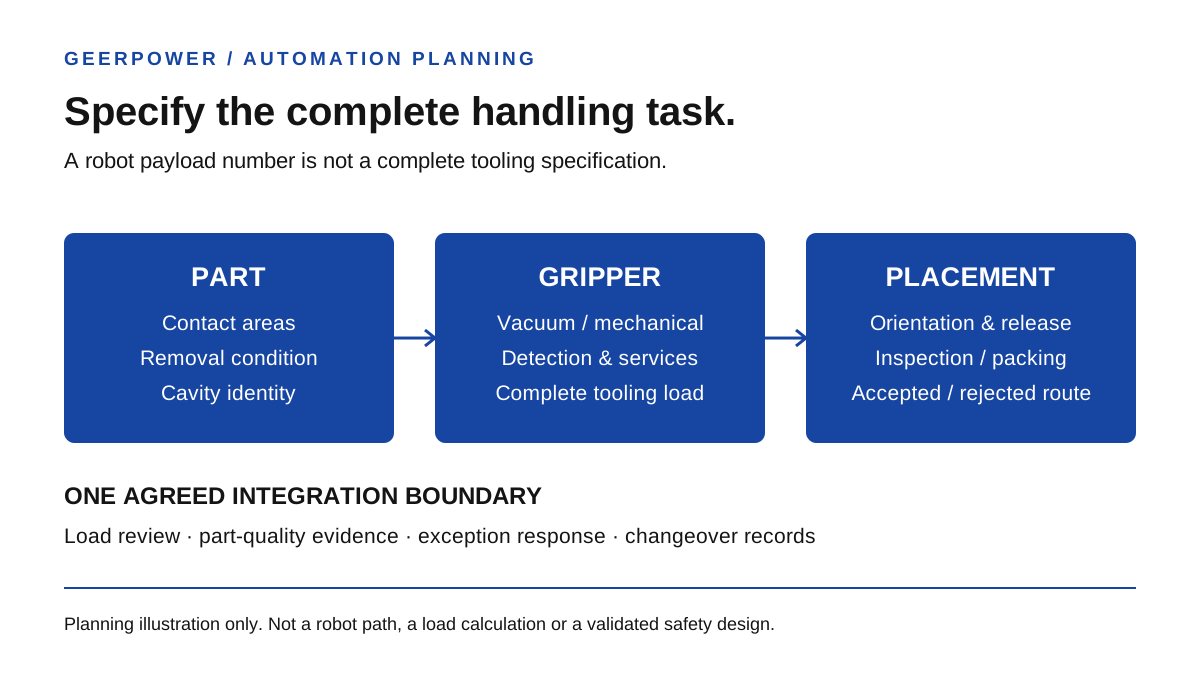
For manual loading, request a qualified review of access, equipment suitability and the complete operating concept. For automated loading, ask about incoming presentation, refill, orientation, empty positions and recovery from a rejected insert. A robot price alone does not include all those tasks. Neither route should depend on bypassing safeguards to achieve a promised cycle.
Choose the machine from the complete process boundary
Do not select a press solely from the finished part's weight or from whether the drive is hydraulic or all-electric. Ask for a mold-to-machine compatibility review that includes the tool envelope, proposed injection unit, opening and removal requirements, loading access and the agreed interfaces. If an existing machine will be reused, supply its actual configuration and available documentation.
Separate the machine's molding sequence from the full production cycle. Insert preparation, placement, confirmation, part removal and downstream inspection may change the achievable output. Ask suppliers to identify which actions overlap and which occur in sequence, then validate the proposed output with production-intent materials and the agreed cell arrangement. This guide does not prescribe a tonnage, architecture or cycle time for an unspecified part.
Make acceptance about the assembly, not just the appearance
Before a trial, agree on identified insert lots, resin lots, cavity identification and the sample record. Have the responsible quality and design teams choose the relevant checks: insert position, exposed functional surfaces, thread usability, assembly dimensions and specified mechanical or electrical performance. Define methods, conditions, quantities and limits in the approved acceptance plan rather than borrowing a percentage from another application.
For an illustrative enclosure with threaded mounting points, a smooth molded surface would not answer whether the mating screw fits correctly or whether the assembled joint meets its required load. Conversely, a satisfactory joint test would not establish every enclosure dimension. Keep each requirement linked to its own result and approval owner.
Ask how missing, wrong or misoriented inserts will be detected and handled, and who will approve a controlled demonstration of that response. Fault demonstrations belong in an integrator-approved test plan with appropriate safeguards; they are not instructions for operators to improvise. Record unresolved items separately from shipment approval.
Compare total scope and send a quotation-ready brief
A lower mold price may exclude insert-feeding hardware, loading fixtures, replacement locating components, trial inserts, inspection fixtures or receiving-site integration. Compare those lines explicitly. Ask who owns fixtures and programs, which wear items are supplied, what documentation is included and how a future insert revision would be handled. These are quotation variables, not fixed GEERPOWER inclusions.
For a GEERPOWER project review, share the part and insert drawings, resin grade, application, required good-part output, available machine information and destination. State whether you need an export mold, a machine-and-mold package or a coordinated automated cell. If some inputs are not released, list the open decisions so the response can separate a preliminary concept from a firm technical offer.
Common buyer questions
Is insert molding the same as two-shot overmolding?
Not necessarily. This guide concerns a preformed metal component placed in a tool before plastic is molded around it. Two-shot processes involve a different sequence. Describe the actual component and process in the RFQ instead of relying on a broad label.
Can I choose the machine using only part weight?
No. The mold, injection requirements, loading and removal concept, utilities and production target also need review. Request a documented compatibility check for the proposed configuration.
Does a molded-in threaded insert guarantee a strong joint?
No universal performance follows from the process name. Specify the joint requirements and validate the actual insert, resin, part design and production process using an approved test plan.
Must insert loading be automated?
Not automatically. Compare demand, product mix, presentation, quality requirements and the qualified safety review. Ask for the complete manual or automated concept, including refill, inspection and exception handling.
What if the insert supplier changes after mold approval?
Use change control. Compare the revised insert specification and ask the design and quality owners which fit checks, tooling reviews and trials must be repeated before production release.
What should I send first to request a project quotation?
Start with the finished-part and insert drawings, resin grade, required output, application and destination. Include existing machine details if equipment will be reused, and identify any unconfirmed technical inputs.
Sources and references used for this guide
This guide supports early project planning. Final machine selection and commercial configuration must be confirmed from the actual part, mold, material, factory utilities and production target.