What should a buyer specify before ordering a robot gripper for injection molded parts?
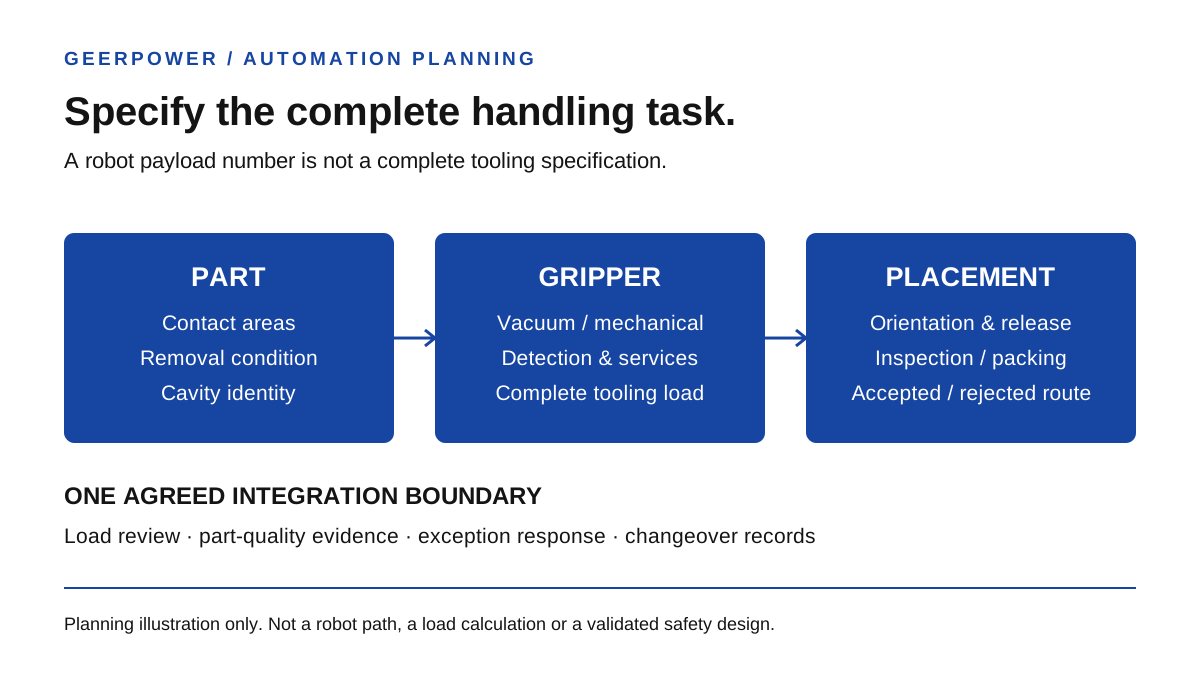
Define the part and runner to be handled, allowed contact areas, removal condition, cavity layout, complete tooling load, robot interfaces and required placement. Ask for a gripping concept, part-quality trial, detection and recovery plan, changeover records and a clear integration owner. A robot payload rating alone does not prove that the tooling suits the application.
Decision checklist
- Mark cosmetic, sealing and functional surfaces before selecting contact points.
- Include tooling, adapters, services, parts and any runner in the load review.
- Compare vacuum, mechanical and combined gripping against the actual part.
- Agree part-presence, cavity identity, reject handling and restart evidence.
- Define the downstream placement and changeover package, not only removal from the mold.
Start with the part at removal, not the robot catalog
End-of-arm tooling, or EOAT, is the working assembly between the robot wrist and the part. In an injection molding cell it may remove molded components, separate handling routes for parts and runners, or place components into an inspection or packing fixture. The useful purchasing question is whether that complete task is defined, not simply whether a robot is included in the machine quotation.
Consider two illustrative applications: a visible enclosure that must arrive without contact marks, and a multi-cavity industrial component that must retain cavity identity for inspection. These are not customer case studies. The first emphasizes allowed gripping surfaces and appearance evidence; the second emphasizes identification and placement. Both need more information than the cooled part's nominal weight.
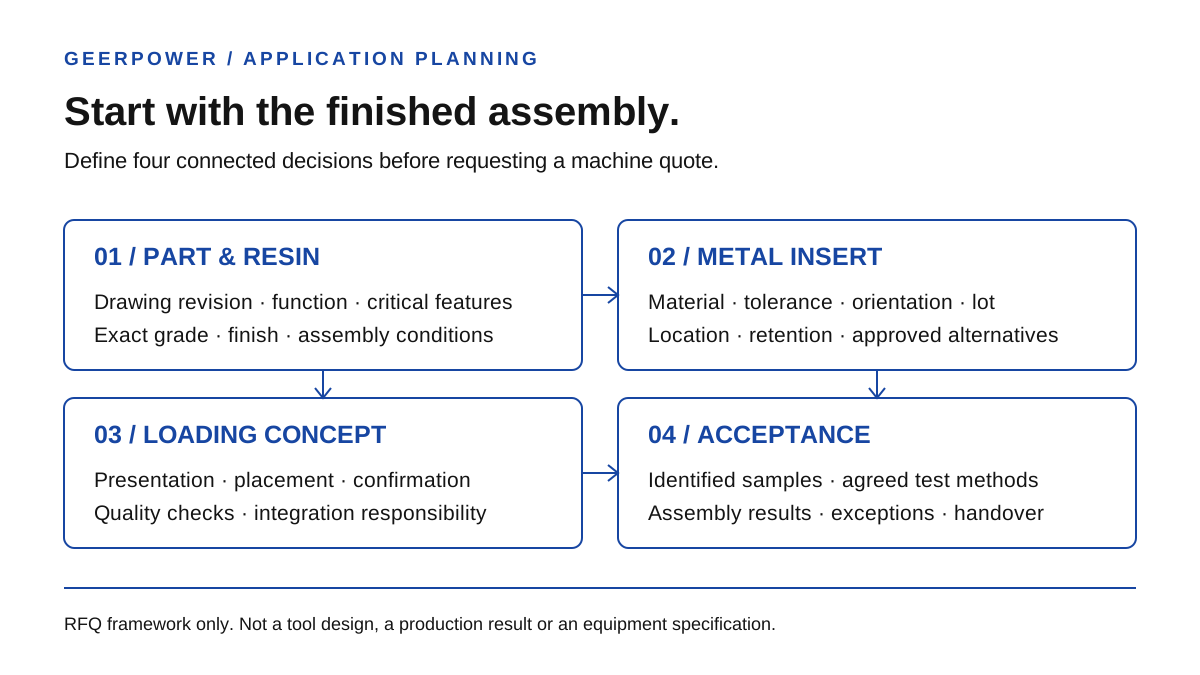
Send the drawing, resin grade, cavity layout and proposed removal condition to the integrator. Identify surfaces that must remain untouched and any dimensional or appearance checks after handling. Ask which assumptions need trial confirmation rather than expecting a catalog selection to settle every question.
Compare vacuum, mechanical and combined gripping
FIPA describes mechanical grippers used for molded-part demolding and sprue removal, alongside components such as gripper arms and quick-change systems. Schmalz describes configurable vacuum end effectors with choices of vacuum zones, connections and suction-cup interfaces. These references illustrate available tooling building blocks; they do not endorse a particular selection for an unknown part or establish a supplier relationship with GEERPOWER.
Use the following questions to structure the quotation. Have the tooling supplier confirm component suitability for the specified surface, temperature and operating conditions. A convenient flat area on a CAD model is not automatically an approved contact area on the finished product.
| Approach | Application question | Evidence before approval |
|---|---|---|
| Vacuum | Can the selected contact areas provide a suitable seal without unacceptable marks? | Cup selection basis, zoning, part-detection concept and production-intent handling trial |
| Mechanical | Are there accessible features that can be gripped without damage or deformation? | Finger/contact design, component ratings and observed part-quality results |
| Combined | Do separate features or tasks need different gripping methods? | Coordinated sequence, complete load review and defined response to a missing part |
| Dedicated runner or sprue handling | Must the runner follow a different route from accepted parts? | Runner identification, separation scope and downstream collection requirements |
Make the complete load and clearance review visible
Ask the integrator for a load record covering the tool frame, grippers, adapter or tool changer, attached services and everything carried during the relevant movement. The robot manufacturer's limits may depend on more than total mass, so request review of the actual arrangement, center of gravity and applicable moment or inertia limits. Do not infer suitability from a simple comparison between part weight and the robot's headline payload.
Request a coordinated layout covering the mold opening, tie-bar or access restrictions, ejector sequence, tooling approach and downstream station. The purpose is to expose conflicts before hardware is ordered. Have the responsible integrator approve the path and operating limits; an illustration in an RFQ is not a validated robot program.
If the cell must handle more than one mold, identify the intended tool changes and the worst relevant configurations. A successful trial with one small part does not validate a heavier tool or a different cavity pattern. Keep each approved combination linked to its configuration record.
Define a usable EOAT specification sheet
A specification sheet should be short enough for purchasing to compare, but specific enough that engineering can identify missing assumptions. The table below is a proposed RFQ worksheet. It does not prescribe universal vacuum levels, gripping forces or acceptance limits. Have the qualified supplier set and justify those values for the application.
| Scope | Buyer input | Supplier response to request |
|---|---|---|
| Part quality | Drawing revision, resin, cosmetic zones and contact restrictions | Marked contact diagram and trial inspection method |
| Mold layout | Cavity identity, runner arrangement and removal sequence | Tool layout and confirmation of reachable positions |
| Robot and services | Robot model, flange, available air/vacuum/electrical interfaces | Compatibility review and complete tooling-load record |
| Detection | Required part-presence and cavity-level information | Sensor scope, signal map and documented exception response |
| Destination | Conveyor, nest, inspection or packing requirement | Placement orientation, release confirmation and downstream handshakes |
| Changeover | Product mix and required operator tasks | Tool identification, setup record and approved parameter backup |
| Handover | Maintenance capabilities and receiving-site requirements | Parts list, wear items, drawings, manuals and training scope |
Test part quality and exceptions, not just a smooth demonstration
Agree a trial using the intended resin, mold, removal condition and downstream arrangement. Ask for an unambiguous record of which components were present and which were simulated. Inspect handled parts against the drawing and appearance requirements after the agreed conditioning period where relevant. A short video of successful removal is useful evidence, but it is not a complete acceptance report.
For a cosmetic enclosure, request a contact-area inspection under the agreed viewing method. For a multi-cavity component, ask how accepted parts preserve cavity identification when they are placed or rejected. For a thin or flexible part, ask which dimensional or assembly checks confirm that handling has not introduced an unacceptable change. The product owner should define limits; the equipment seller should not silently invent them.
The acceptance plan should also define how the system responds to missing parts, an unsuccessful pick, downstream unavailability and restart after an interruption. Those demonstrations must be designed and executed by qualified personnel within an approved test and safety plan. This article is not a fault-injection procedure and does not authorize entry into a cell or the bypass of any safeguard.
Quote the full cycle and the changeover work
Ask each supplier to state where its cycle begins and ends. Removal from the mold, travel, placement, inspection and return may not be represented by the same timing number. Compare good-part output under the same agreed conditions, including any actions that cannot overlap. Do not accept a universal cycle saving or a return-on-investment estimate without the operating assumptions and trial basis.
For a useful operating-cost comparison, separate purchase cost, wear components, maintenance tasks, setup time, service support and expected product changes. Request the assumptions behind any labor calculation. A quoted robot does not automatically remove every operator task: material replenishment, checks, packing and approved recovery still need assigned responsibilities.
A changeover package should identify the tool, approved setup, connections, stored program or parameter revision and the checks required before release. Ask what can be replaced locally and what requires supplier support. Clear ownership of drawings and backups matters when a small tooling issue would otherwise stop the entire cell.
Put one owner in charge of the integration boundary
The machine supplier, robot supplier, EOAT builder and downstream-equipment supplier may each deliver a working component while leaving the complete sequence unassigned. Name the party responsible for coordinating interfaces, risk assessment, acceptance evidence and the final handover. Record the boundary between factory acceptance and the receiving site's installation work.
For a GEERPOWER automation review, provide the part drawing, mold and cavity layout, available robot and machine details, production target, permitted contact areas and the required downstream destination. State whether the project concerns an existing cell or a new machine-and-mold package. The resulting scope should identify missing information and separate confirmed requirements from assumptions before equipment is quoted.
Common buyer questions
Is EOAT normally included in a robot quotation?
Do not assume so. Request a separate scope covering the tool, adapters, sensors, services, programming, trials and downstream integration. The included items depend on the supplier's written offer.
Is vacuum gripping always better for plastic parts?
No. Selection depends on usable contact areas, surface and removal conditions, appearance limits and the handling task. Compare vacuum, mechanical and combined concepts using application-specific evidence.
Why is part weight alone insufficient for robot selection?
The robot also carries the tooling and other attached items. The complete arrangement must be checked against the manufacturer's relevant load, center-of-gravity, moment and inertia limits, as applicable.
Can one EOAT handle multiple molds?
Possibly, but each part layout, gripping condition and tooling configuration needs review. Define the changeover method and validated combinations rather than assuming one successful trial covers all products.
Does a successful pick prove the automation is accepted?
No. The agreed evidence should also address part quality, placement, identification where needed, exception handling and handover. Keep those decisions separate from a short demonstration.
What information is most useful for an initial automation review?
Send the part drawing, resin, cavity arrangement, available machine and robot details, output target, allowed contact surfaces and downstream placement requirement. Mark unconfirmed inputs so they can be resolved before a firm quotation.
Sources and references used for this guide
This guide supports early project planning. Final machine selection and commercial configuration must be confirmed from the actual part, mold, material, factory utilities and production target.