How do I select an injection molding machine for existing molds?
To select an injection molding machine for existing molds, confirm four things separately: the tool physically fits; the injection and clamping systems support its process; the utilities and automation can connect; and a documented trial can demonstrate acceptable parts. Matching the old machine's tonnage is a starting point, not a purchase specification.
Decision checklist
- Identify the molds that must run at launch and attach the current drawing revision.
- Review physical fit, process capability, utilities and automation separately.
- Compare complete quotation scope rather than base machine prices.
- Agree trial conditions, acceptance evidence and unresolved items before ordering.
When this checklist is useful
A factory replacing a press often wants to keep valuable tooling in production. Another may be moving a molding program in-house or adding capacity for a proven product. In each situation, a new machine should be evaluated against the molds it must run—not selected from a photograph or a headline clamp-force figure.
This guide is for buyers who already own production molds or have approved tooling drawings. It is not a mold-design calculation, a machine operating procedure or a substitute for the equipment supplier's engineering review. Its purpose is to produce a clearer RFQ, expose costly mismatches early and give competing quotations a common basis.
Start with a mold portfolio, not a machine model
Create one row for every tool the new machine must run. Identify the launch-critical molds first and separate them from future possibilities. Record the part number, drawing revision, resin grade, active cavity count, tool weight and previous production machine. Attach recent accepted samples and the current quality requirements.
Then distinguish three statements: “runs today,” “must run at launch” and “would be useful later.” These are different purchase obligations. If ten molds are mentioned informally but only two are reviewed, a supplier cannot reasonably treat the other eight as proven compatible.
A practical RFQ cover sheet should name the priority molds, required acceptable output and unresolved information. Missing dimensions should have an owner and a due date. This is more useful than asking for the largest press that fits the budget.
Check physical fit as a complete interface
A mold-transfer review includes tool size and height, platen and tie-bar clearances, nozzle and locating features, ejection, cooling and auxiliary connections. Hansen Plastics describes these as connected compatibility questions rather than a single tonnage check. Its guidance is about transfer planning, not evidence that any specific GEERPOWER configuration is suitable.
Use the following as a buyer's review worksheet. Ask the supplier to fill the proposed-machine column with drawing references, not just “yes.”
EUROMAP's technical recommendation catalogue separately addresses mold-fixing dimensions, core-puller interfaces, hot-runner connections and robot interfaces. That separation is useful when organizing the specification: one compatible connection does not establish compatibility of the complete cell. A catalogue reference is also not a certification of the supplied machine.
| Review gate | Buyer input | What the quotation should resolve |
|---|---|---|
| Installation envelope | Mold drawing, overall size and lifting arrangement | Installation route and operating clearance |
| Mounting and support | Tool weight, fixing layout and locating details | Written mounting compatibility or identified adaptation |
| Opening and removal | Required opening, part depth and removal concept | Clearance for the part, runner and intended handling system |
| Ejection and movements | Ejection arrangement, core actions and sequence | Required strokes, interfaces, options and control scope |
| Material and process | Resin grade, part/runner data and process history | Injection-unit review and items requiring a trial |
| Utilities and peripherals | Factory services and retained auxiliary equipment | Connection requirements and buyer/supplier responsibilities |
| Acceptance | Drawings, sample criteria and output target | Test conditions, records and approval authority |
Treat process transfer as a new validation task
An existing setup sheet is valuable, but copying controller values to a different press is not proof of an equivalent molding process. RJG's published discussion of universal setup data explains the value of machine-independent process information when moving tooling. It distinguishes plastic conditions from machine-specific settings and considers the receiving equipment as part of the review.
For purchasing purposes, ask the engineering teams to identify which existing records are comparable, which require conversion or interpretation, and which need to be measured again. Include the resin grade and approved quality criteria with those records. Do not ask the commercial team to promise the old cycle time before the receiving configuration has been evaluated.
For a quality-sensitive program, define the customer's approval process before the purchase order. The necessary sampling and validation work depends on the product and its requirements. A successful previous production run is supporting history, not automatic approval for the new installation.
Compare hydraulic and all-electric routes against the same brief
GEERPOWER presents both servo-hydraulic and all-electric machine routes. When an existing mold is the constraint, compare the proposed configurations against the same fit, quality, output, utility and acceptance requirements. Do not let a drive-architecture label replace that comparison.
Ask both quotations to state the injection unit, required mold functions, peripheral interfaces and included options. If one offer includes a robot connection or core-pull package and the other excludes it, the base prices are not yet comparable.
Energy comparisons also need a defined boundary. EUROMAP 60.1 describes a machine-related efficiency method and distinguishes it from product-related measurement under EUROMAP 60.2. Ask what equipment and operating conditions a quoted figure includes; do not apply an unverified saving percentage to a different product or cell.
Use the hydraulic versus all-electric comparison to structure the discussion, then request application-specific evidence for the shortlisted configuration.
Budget the transfer, not only the press
The useful comparison is the cost of an accepted production setup. Build a worksheet with separate lines for the machine, required options, tooling adaptations, auxiliaries, transport, site preparation, trial material, validation and operator handover. Mark each line as included, excluded, buyer-supplied or awaiting a quotation.
Do not enter a zero against an unknown. An unpriced electrical connection or mold adaptation is still an open scope item. Record who will investigate it and whether it could change the machine selection or launch date.
Illustrative decision—not a customer case
Suppose a factory compares two quotations for a press intended to run an existing housing mold. Offer A has a lower base price but leaves a required mold movement and part-removal interface unresolved. Offer B identifies the interfaces and lists the required options separately. The next action is to close A's gaps and compare complete scope; it is not automatically to select either offer.
This example contains no claimed saving or performance result. It illustrates a procurement rule: compare resolved requirements before comparing totals. If several suppliers must coordinate the cell, define those boundaries through a turnkey injection molding project review.
Agree the acceptance evidence before ordering
Create a test plan that names the molds and materials available for the trial, the product characteristics to inspect and the operating conditions to record. Clarify which checks occur before shipment and which depend on installation at the buyer's factory.
DIN Media lists ISO 20430:2020 as a safety-requirements standard for injection molding machines. Referencing a standard does not establish the certification or compliance status of a machine pictured on a website. Ask qualified personnel to define the applicable safety and destination requirements for the proposed machine and integrated cell.
Give every acceptance item an evidence format and an approver. A photograph may document configuration; a trial report is needed for agreed production results. If the buyer's mold is unavailable, record exactly what the alternative test can demonstrate and what remains open. Never silently convert an untested requirement into a pass.
The pre-shipment FAT checklist provides a complementary review of machine identity, ordered configuration, trial conditions and handover records.
Send an RFQ that can lead to a useful recommendation
For the first GEERPOWER discussion, send a part photo or drawing, resin grade, mold drawing or available dimensions, desired output and destination. If a requirement is not yet known, label it clearly. A complete engineering file is not necessary to start a conversation, but missing inputs must remain visible.
Request three outputs from the review: a proposed machine route, a list of unresolved technical points and a clearly bounded quotation scope. Ask which priority molds have actually been assessed. Keep the same revision of the RFQ with each supplier so later changes can be traced.
Have existing molds and a machine-replacement project? Request a GEERPOWER project review. Attach the available tooling information and state which molds must be running first. For commercial enquiries, email Jim@geerpower.com.
Common buyer questions
Can I select a replacement machine by matching tonnage?
No. Clamp force is only one selection variable. The reviewed scope must also address mold fit, injection capability, mold functions, utilities, automation and acceptance. Ask for confirmation against each priority mold.
What if the mold drawings are incomplete?
Begin with available photographs, records and tool identification. Ask the responsible engineering team to establish which measurements and interface details must be verified before an offer becomes a final configuration. Do not estimate critical dimensions from a product photograph.
Will the old cycle time carry over to the new machine?
Not automatically. Treat it as a target supported by historical records. Agree how the proposed machine, tooling, material and production cell will be evaluated before making an output commitment.
Should an RFQ include auxiliary equipment already in the factory?
Yes. Identify equipment you intend to retain and provide its relevant interface and utility information. The scope should say whether adaptation, replacement or further review is needed.
Is the pictured machine available in a confirmed configuration?
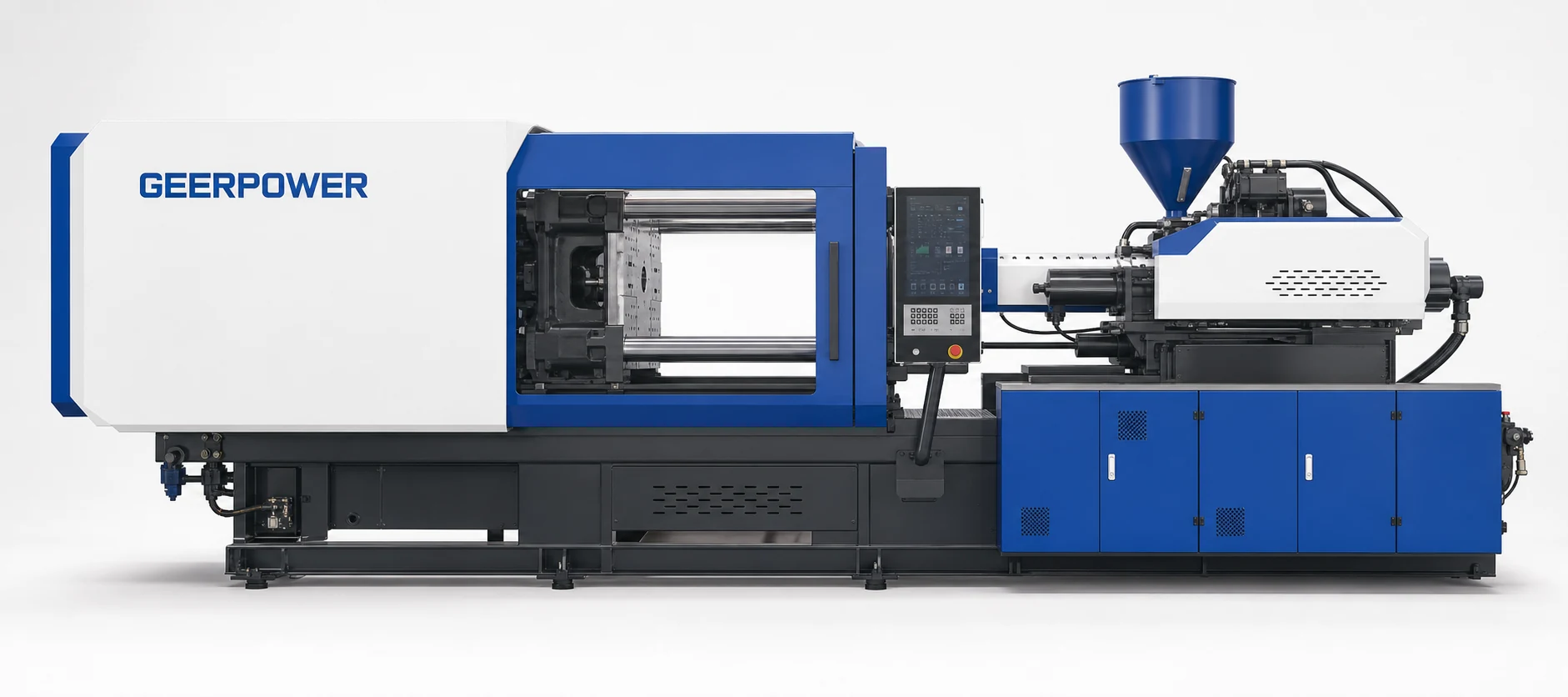
The image is a GEERPOWER product visual, not an inventory or specification record. Ask for a current project quotation confirming model, options, technical data, price and delivery before ordering.
Can I request a coordinated machine, mold and automation proposal?
Yes. Use the project-review route and identify the desired scope. The proposal should separate the machine, tooling work, automation, auxiliaries and buyer-site responsibilities so each item can be reviewed and agreed.
Sources and references used for this guide
This guide supports early project planning. Final machine selection and commercial configuration must be confirmed from the actual part, mold, material, factory utilities and production target.