On this page
What should a buyer request to judge the filling balance of a multi-cavity injection mold before acceptance?
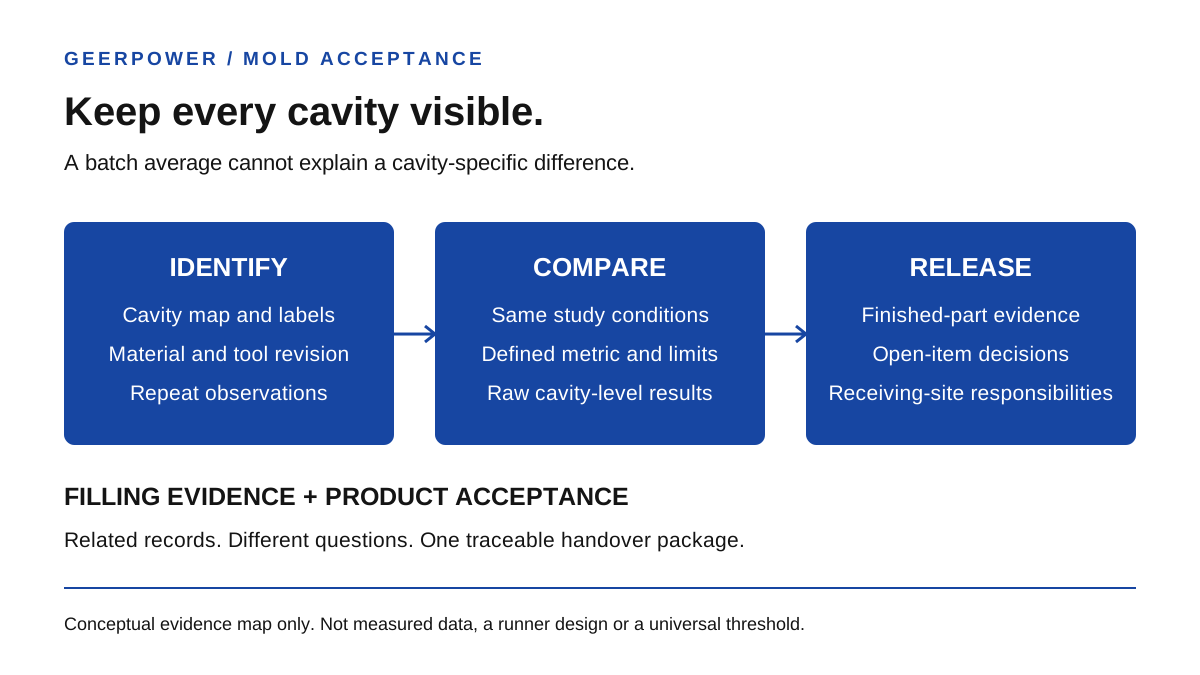
Request a numbered cavity map, a documented study method, material and process conditions, cavity-identified samples and raw results for repeated observations. Agree how the chosen balance metric is calculated and what its limit means. Review filling evidence separately from packing, dimensions and functional results, then close cavity-specific exceptions before approving the agreed release milestone.
Decision checklist
- Match every result to a cavity number and an identified study condition.
- Separate filling-study samples from fully molded production samples.
- Compare results using the same method, material basis and calculation.
- Keep cavity-to-cavity variation distinct from changes between successive cycles.
- Require finished-part approval and documented exceptions as well as a balance chart.
Why a batch average can hide the purchasing risk
Consider an illustrative mold producing several small industrial components per cycle. The supplier reports an acceptable average part weight, but does not identify the individual cavities. A consistently heavier cavity and a consistently lighter cavity can disappear into the average. This example is a review problem, not a reported GEERPOWER project or evidence of a particular defect.
The buyer needs to know which decision the supplier's chart supports. A study of how cavities fill, a report on completed-part weight and a dimensional acceptance report are related records, but they are not interchangeable. Start by asking what was measured, under which conditions and how the result is linked to each cavity.
Beaumont's Molding Genius description uses short-shot weight information to analyze filling imbalance and distinguishes different sources of variation. It supports requesting a defined study rather than relying on a visual runner layout. It does not establish a universal acceptance percentage or imply that GEERPOWER uses that software on every project.
Agree the study boundary before collecting samples
Ask the supplier's qualified process team to define the study in advance. Record the purpose, method, material grade and lot, mold revision, machine configuration and relevant process conditions. State which equipment is actually present and whether any production-intent components are substituted. The buyer should review the resulting evidence, not improvise a process change at the press.
Include a cavity map that the sampling team and receiving quality team can both interpret. Define how each sample is separated, labeled and retained, including family molds that intentionally produce different components. Comparing unequal parts by raw weight alone does not create a meaningful cavity-balance decision.
This is a procurement checklist, not operating instructions for making incomplete shots or changing process controls. Study execution, equipment suitability and safety remain with trained personnel following the equipment and material instructions and the approved trial plan.
| Record | Minimum review question | Why it matters |
|---|---|---|
| Study objective | Is this filling progression, completed-part variation or another named test? | Different questions need different evidence. |
| Cavity map | Can every sample and result be traced to its physical cavity? | An anonymous dataset cannot identify a cavity-specific issue. |
| Material and process basis | Which grade, lot, mold revision and machine configuration apply? | Changed conditions can invalidate a direct comparison. |
| Method and observations | What is collected and how are repeats identified? | One convenient observation may not represent the agreed trial. |
| Calculation and limits | What formula, denominator, units and exclusions are used? | Two percentages may describe different quantities. |
| Release responsibility | Who approves exceptions and which milestone is affected? | A study result is not automatically shipment or production approval. |
Keep filling, packing and finished-part quality separate
A filling study is useful for comparing the distribution of material during the defined filling condition. Fully molded parts also reflect the subsequent process and the product's geometry and material behavior. Ask for the supplier's interpretation of each dataset and avoid relabeling a completed-part weight chart as a complete filling study.
RJG's discussion of cavity pressure explains why machine-side stability and part weight are not sufficient proof of every dimensional requirement. Our buyer-side recommendation is to keep the process evidence and the product acceptance evidence connected, while retaining their different meanings. Installing a sensor or producing a curve does not automatically approve a molded part.
If in-mold measurements are included, request the sensor locations, channel-to-cavity mapping, units and the conditions under which curves were collected. If those measurements are not in the contract, ask which other evidence will answer the agreed question. Do not assume a particular instrument or proprietary method is mandatory for every mold.
Require an explicit metric instead of an unexplained percentage
A statement such as balance within a certain percent is incomplete unless the supplier defines the calculation. Ask whether it refers to a range, a deviation from a target, a difference from the mean or a software-specific measure. Also ask whether the result applies to each observation or only to a cumulative dataset.
For an arithmetic illustration only, suppose four comparable observations are 9.9 g, 10.0 g, 10.0 g and 10.1 g. Their mean is 10.0 g. Under a specifically chosen weight-spread formula of maximum minus minimum, divided by mean and multiplied by 100, the result is 2%. The maximum absolute departure from the mean, divided by the mean, is 1%. These are different descriptions of the same invented numbers.
Neither value is a recommended acceptance limit, a universal filling-balance definition or an actual test result. Put the selected formula in the approved plan and preserve the underlying readings. The example shows why percentages from two offers cannot be compared until the methods match.
| Quantity | Useful comparison | Important limitation |
|---|---|---|
| Between-cavity result at one study condition | Which cavity differs from the others? | Does not establish repeatability over time. |
| Repeated result from the same cavity | Does that cavity change between observations? | Does not describe the entire mold by itself. |
| Completed-part weight | Does the recorded mass vary under the trial conditions? | Does not prove every dimension or functional property. |
| Drawing and functional results | Do identified samples meet the agreed product requirements? | Applies only to the tested revisions and conditions. |
Do not diagnose the cause from the runner sketch alone
A geometrically tidy runner drawing is not the same as a demonstrated balance result. Ask for evidence that the proposed material, tool and process have been evaluated together. If simulation is offered, retain the input assumptions and compare the prediction with the relevant trial observations before treating the issue as closed.
When a cavity differs, record the observation first and keep the proposed cause separate from the evidence. Have the supplier investigate the applicable flow path, tooling condition, gate and vent features, thermal conditions and process repeatability within its qualified review. Do not assume every imbalance can be corrected by one adjustment or by modifying a gate.
If the supplier changes steel, a hot-runner setting or a process condition, request a change log and the affected repeat checks. The buyer should be able to see what changed between the original and revised reports. A new chart without revision traceability does not explain whether the same study was repeated.
Use a practical release and handover checklist
Before the trial, agree which characteristics are checked by cavity and how the sample plan covers the required production conditions. Let the responsible quality team set the sample quantities and limits. Do not borrow a capability threshold or a balance percentage from an unrelated mold just because it appears in another supplier's report.
At the release review, bring together the cavity map, raw observations, calculation, process record, dimensional results, agreed functional evidence and the exception list. Identify whether the decision authorizes shipment, a further trial or production use at the receiving site. Keep these milestones separate when installation and site-specific work remain.
For an export mold, include the approved process and inspection records in the handover package and identify what must be reproduced after transfer. The receiving machine, material supply or utilities may differ from the trial setup. Agree who assesses those differences and which verification is required; do not describe a factory trial as proof of a cell that has not yet been assembled.
- Trace every dataset to the same mold and revision.
- Retain all observations, including excluded data with its explanation.
- Identify accepted and unresolved cavities or requirements.
- Record the approval owner and the remaining release conditions.
- Keep the receiving-site verification responsibility explicit.
What to send for a GEERPOWER mold-acceptance review
Share the part drawings, resin grade, cavity layout, required good-part output, proposed machine configuration and the acceptance requirements already agreed with your quality team. If a study exists, send its raw cavity-level data and method as well as the summary chart. Identify which production conditions were represented and which are still assumptions.
Ask the offer to separate mold manufacture, study support, process monitoring where requested, sample inspection, corrective trials and receiving-site support. These activities affect scope and should not be inferred from a general turnkey label. A useful review makes the next technical decision clear without promising an unverified cycle time, yield or quality result.
Common buyer questions
Does a geometrically balanced runner prove equal cavity filling?
No. Request the agreed study under defined material, tool and process conditions. A drawing describes geometry; it is not measured trial evidence.
Can completed-part weight replace a filling study?
Not without explaining the purpose and method. Completed-part weight reflects more than the defined filling stage and does not establish every dimensional or functional requirement.
What balance percentage should every mold achieve?
There is no universal value supplied by this guide. Agree an application-specific method, formula and limit with the responsible supplier and quality team before testing.
Why keep cavity numbers on the samples?
Cavity identity lets reviewers connect a result to a physical location and distinguish persistent cavity differences from variation over successive observations.
Must every project buy cavity-pressure monitoring?
No such requirement follows from this article. Define the question and the evidence needed, then agree the appropriate study and equipment within the project scope.
Does a passing factory study complete site acceptance?
Not necessarily. Agree which receiving-site conditions differ, who reviews the transfer and what verification remains before production release.
Sources and references used for this guide
This guide supports early project planning. Final machine selection and commercial configuration must be confirmed from the actual part, mold, material, factory utilities and production target.